The risks, explained without the marketing
This is the household economics reading of an offshore casino session. We show the expected loss maths on a real fifty pound weekly habit at a licensed rate of return and at a typical offshore rate; we set out the sunk cost trap in plain terms; and we translate the missing consumer protections into pounds that a household budget can weigh.
No UKGC oversight, what that means day to day
The most useful way to understand the risks of playing outside GamStop is to price them, in pounds, against the household budget that pays for them. A household with a fifty pound weekly slot habit is spending two thousand six hundred pounds a year of deposits before any wins are subtracted. Return to player, the fraction of every pound wagered that a game returns to customers in aggregate, is not the same thing as the fraction of every pound deposited that the household keeps at the end of a session, because each pound is wagered several times inside a normal session before it is exhausted. At a licensed return-to-player rate of around ninety six per cent, and a typical churn of around ten wagers per pound before that pound is used up, the expected annual loss on a fifty pound weekly habit is close to one thousand and forty pounds; at an offshore rate closer to ninety two per cent, the same churn produces an expected loss around two thousand and eighty pounds. The difference in the operator's per-pound margin doubles the household's expected annual cost.
Day to day, what a UK household loses at the border with the offshore market is not only the four percentage points in the game's return-to-player rate. It is also the set of licence conditions that a UK Gambling Commission operator has to run inside its business. Affordability checks at defined spend thresholds, marketing rules that limit how a bonus is framed, stake caps between two and fifteen pounds on online slots under the 2023 White Paper reforms, complaints handling under a fixed timetable, self-exclusion enforcement through GamStop; all of those pieces of infrastructure are missing on the offshore side. The household member on that side is not only paying a higher expected loss, they are also paying it in a market with less friction between craving and deposit, which is where the pound cost of that friction really lives.
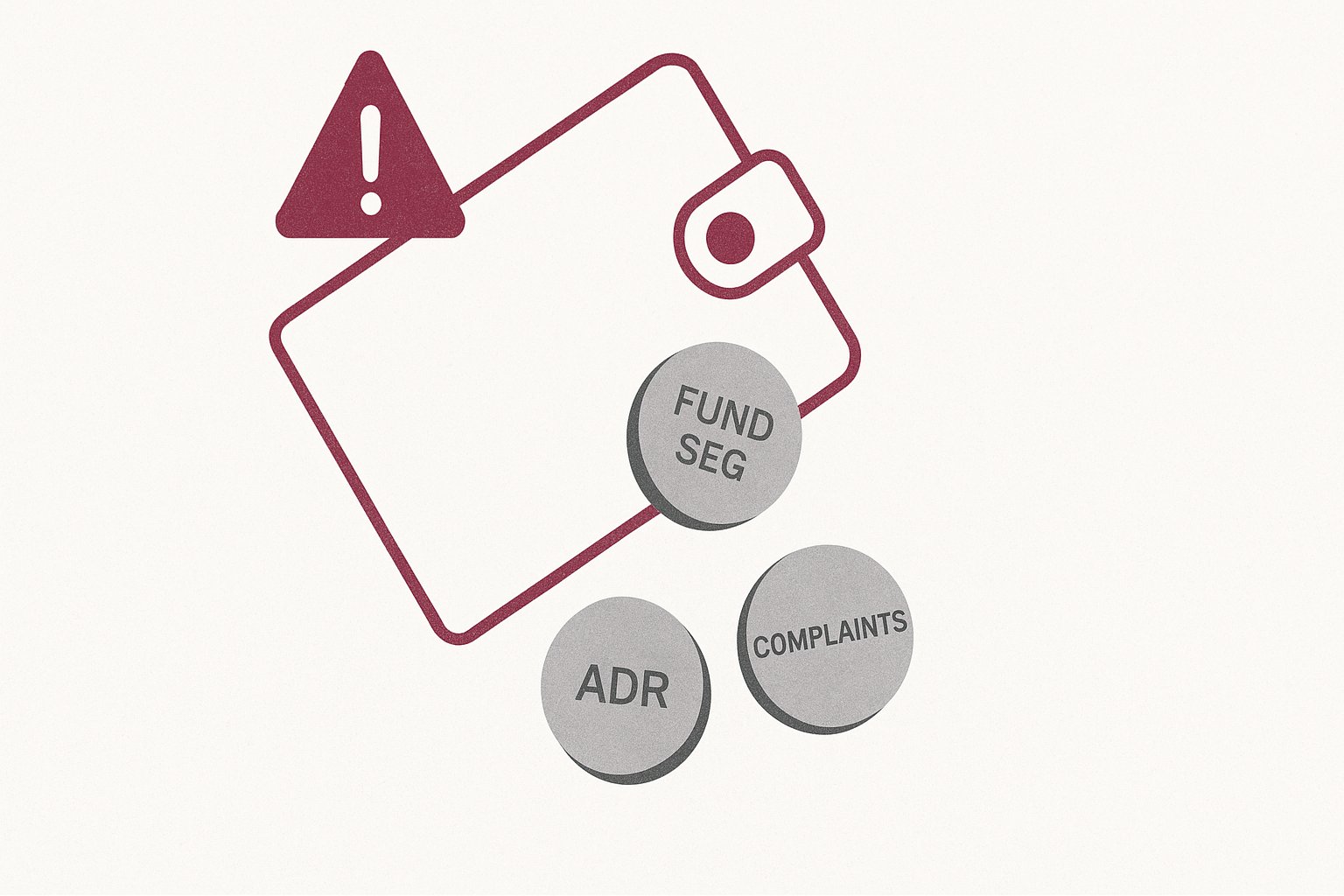
02No fund segregation guarantee
Inside the UKGC licensed market the operator is required to hold customer balances under a fund protection arrangement, with a level of segregation disclosed to the customer at sign-up under the licence conditions. That arrangement is not a bank-style guarantee, but it does place the customer's balance in a defined bucket that the operator's general creditors cannot simply reach in an insolvency. In pound terms it means that a customer's account balance on the evening of an operator failure is not automatically the same category of loss as, for example, a pre-paid deposit to an unregulated online retailer that has gone into liquidation with the money held on its own balance sheet. There is still risk, but the risk is bounded by the fund-protection arrangement rather than by whatever the operator happens to have done with the cash.
Offshore, there is no equivalent obligation on the operator to segregate customer funds under a UK-recognised framework. The account balance sits with the operator, on terms the operator has drafted, in a jurisdiction the household does not usually understand in detail. If the operator becomes insolvent or simply decides that a bonus term has been breached and refuses a withdrawal, the household is not queueing in a UK-supervised process; it is queueing in the operator's own dispute mechanism or in a civil-claim process in a foreign court. Priced against the licensed alternative, the difference is not a fringe consideration. It is the reason a consumer economist would treat an offshore account balance as materially less liquid than the same numerical balance held at a UKGC licensee, even before any dispute has arisen.
A closer look
Households often think about their gambling account balance as a kind of savings, especially after a win. That reading does not survive contact with the offshore terms and conditions. A balance in an offshore wallet is a receipt for a service already priced in, held by a counterparty in another jurisdiction, subject to bonus wagering conditions and to withdrawal limits that are usually set in the operator's favour. Treating it as if it were a bank deposit is a form of the endowment effect, where a small balance held on the customer's behalf feels more like their money than it functions as. The plain habit that saves a household budget here is to withdraw promptly and often, not to leave a balance sitting with an offshore operator for longer than the next withdrawal cycle permits.
03No mandatory ADR body
Alternative dispute resolution inside the UKGC licensed market is a free service to the customer, provided by bodies approved under the regulator's framework and required to meet standards set by the Chartered Trading Standards Institute. In household budget terms that free service represents a real, if invisible, subsidy; the cost of running the dispute machinery is carried by the licensees under their licence conditions and by the wider regulatory apparatus, and the individual customer does not see a bill for it. That is what a supervised consumer market looks like from the household side of the ledger.
Offshore, no equivalent mandatory ADR route is attached to the transaction. Some jurisdictions maintain a regulatory body that offers a form of complaints procedure; some do not. Even where a procedure exists, its accessibility to a UK household is usually poor, its timelines are usually long, and its ability to enforce a favourable decision on a distant operator is not the same as a UKGC licence condition. Consumer economists tend to price the absence of a free complaints route as a small but real premium the household is paying for the offshore transaction, on top of the higher operator margin. A household reading this piece for the first time can usefully add that premium to the return-to-player difference before deciding whether the net offer is one it wants to take.
04Offshore licensing landscape after Curacao LOK 2024
The Landsverordening op de Kansspelen, the Curacao gaming legislation known as the LOK, came into force on 24 December 2024. It replaces the master-licence structure that shaped the offshore online gambling market for two decades and creates a single regulator, the Curacao Gaming Authority. In household household-facing terms, the change tidies up the paperwork on the operator's side. The operator now holds a direct licence from the CGA rather than a sub-licence from a master licensee, and the operator's licence page usually reflects that in the small print at the bottom of the site.
The reform does not import UK consumer protection law, it does not attach a UK dispute resolution route to the operator, and it does not bring the operator inside GamStop. The pound cost side of the offshore transaction, for a UK household, is largely unchanged. What the reform does change is the salience of the licensing story, and the risk that a household reads a recognisable regulator name as a substitute for the substantive protections it does not have. Behavioural economists call that authority bias; the presence of any recognised-sounding regulator lowers the perceived risk of the transaction even when the actual protections have not moved. Reading the licence text closely, and asking what specific remedy is available on a specific type of complaint, tends to correct that reading quickly and moves the household conversation back to the pound figures rather than the paperwork.
Key points
- Expected annual loss on a fifty pound weekly habit is around one thousand and forty pounds at ninety six per cent RTP, and around two thousand and eighty pounds at ninety two per cent
- Fund segregation is a UKGC licence condition; there is no equivalent obligation on the offshore side
- Sunk cost reasoning turns a planned loss into an unplanned one; a written session limit is the best defence a household has
Anjouan, MGA, Gibraltar, how they compare
Different offshore jurisdictions offer different licensing regimes, and a household reading operator small print will meet several of them. Curacao's reformed regime under the LOK, described above, is now the largest offshore licensor by operator count in the market that reaches UK residents. The Malta Gaming Authority operates a more developed rulebook and a public dispute mechanism, but it is still not a UKGC licence and it does not attach a UK complaints route to the operator. The Gibraltar Licensing Authority regulates a smaller cohort of operators, most of which are also UKGC licensed for their UK-facing brands and use the Gibraltar licence for other markets. Newer regimes such as the Union of Comoros Anjouan licence sit further down the recognised-name scale and offer thinner protections in practice.
The consumer economics reading across these jurisdictions is that a licence is not a homogeneous product. Its value to the customer depends on the enforcement toolbox behind it, the size of the regulator's staff, the accessibility of its complaints procedure, and the degree to which its decisions are enforceable against an operator in another country. None of these regimes replicates a UKGC licence for a UK household, and reading them as differently priced versions of the same protection over-states the substitutability. A UK household comparing two offshore operators from two different jurisdictions is comparing two versions of a lightly regulated transaction rather than a licensed one and a slightly less licensed one, and pricing them against the licensed baseline rather than against each other tends to be the more useful conversation for the household budget over any planning horizon longer than a single session.
A closer look
The near-miss dynamic on a slot game does not depend on which jurisdiction the operator sits in. The reinforcement schedule, the audio design and the timing of the small frequent wins are the same across regulated and unregulated venues, because they are the industry standard for that product type. What differs across regimes is not the psychology of the game but the framework around the game. That is the reason a licence page is not a substitute for a household budget conversation; the licence changes the framework, it does not change the pull the game itself is exerting on the person's reward system in the moment.
06Payment friction that is only growing
UK banks have been quietly building the most useful piece of consumer protection a household has in this space, which is the voluntary card gambling switch. HSBC, Monzo, Starling, Lloyds and Barclays now let a customer turn off gambling merchant category transactions with a single tap in the mobile app, and each of them applies a reactivation delay before the switch can be reversed. Visa and Mastercard's 2025 joint taskforce with the UK Gambling Commission has tightened merchant category enforcement across the card networks, so the ability of an offshore operator to be miscategorised at the terminal has narrowed. Anti-money-laundering flags on suspicious deposit patterns have become more sensitive since the Money Laundering Regulations 2017 came into force and were amended to reflect the fifth EU directive.
Behavioural economics tells us that friction beats intent. A household that has switched on the bank block has closed one of the strongest substitution routes for the impulsive self, and it has done so in a way that a craving spike cannot easily reverse. The consumer economics reading is that the payment stack is now doing a share of the harm-reduction work that used to sit on the person alone. That is a change in the shape of the household's defences, and it is one a household can act on without any operator's help. Turning on the voluntary switch, and letting the reactivation delay hold, is often the single highest ratio of protection to effort available in this space.
What happens to your ID documents
Every UKGC licensed operator runs know-your-customer checks on registration and further identity verification at defined thresholds, under the Money Laundering Regulations 2017 and the licence conditions. The documents the customer uploads sit inside a UK data-protection framework, with a data controller that is answerable to the Information Commissioner's Office and a defined set of rights the customer can exercise, including subject access, correction and erasure requests. In household terms that means the passport image and the utility bill uploaded to a licensed operator are treated under UK rules, with UK routes for the customer if something goes wrong.
Offshore, the picture is different in ways a household should read before uploading. The operator's data controller usually sits in the operator's jurisdiction, and the customer's rights over the data are those the operator's local framework provides rather than those UK law provides. In practice that has meant slower and less predictable responses to subject access requests, and it has meant a longer chain of hands between the customer and the underlying document. A household budget that considers the ID upload as a one-off transactional step is under-counting the ongoing exposure of the document. Treating the ID upload as a costed step, not a free one, is closer to the honest household reading. The pound cost of that step is not always payable in cash; sometimes it is payable in the time it takes to correct a record the operator has held longer than the household expected, and sometimes it is payable in the exposure of a document that has ended up in a data set outside the household's line of sight.
08Practical harm-reduction if a deposit has already gone
If a deposit has already gone, the honest household reading is that the deposit is a sunk cost. Behavioural economics is very clear on the pull to keep spending because money has already been committed, and the pull is stronger on a live session where the operator's site is set up to keep the person engaged. The single most protective step at that moment is to close the session at the original planned loss, without treating past deposits as arguments for future ones. The past deposit is out of the household budget already; the next deposit is not, and the next deposit is the only one the household still controls. Naming the trap by its name, in the moment, is often what tips the decision back to the reflective self, because the trap has less pull once the household has a word for it and a script for what to do when it appears. A household that has agreed, in advance, that any session which reaches the original planned loss is closed for the night has taken the decision out of the moment and placed it in a calmer conversation the members had earlier, which is precisely the pattern that behavioural economics has found delivers the strongest reduction in impulsive spending over a full year.
The practical steps beyond that are unglamorous, and that is a feature rather than a fault. Switch on the voluntary card gambling block at the household's UK bank; close the operator's browser tab and clear the auto-fill on the login form; write a short household note about the session, including the pound amount and the mood it was placed in, for the reflective self to read the next time; call the National Gambling Helpline on 0808 8020 133 if any of this feels harder than it should; and check the household calendar for the GamStop registration if a boundary against the licensed market is what the reflective self decides it wants next. None of those steps is a heroic intervention; they are the small, boring, effective moves that consumer economics has consistently found work better than large plans that a household cannot keep to. The literature on behaviour change is consistent that reductions in impulsive spending come from the environment rather than from the resolve, and the environment a UK household can shape this week includes the card, the browser, the phone, the calendar and the conversation, none of which requires the operator's cooperation to change.
Read next
- GamStop explained, the scheme, the periods, the checks
- The legal position for UK players outside GamStop
- Payments and checks, banks, cards, crypto, KYC
- Coming off GamStop, the official route
- Getting support, helplines, clinics, family, money
Sources and verification
Verified against public UK sources including begambleaware.org for household-facing risk and harm-reduction guidance underpinning the behavioural framing on this page. Last checked 5 August 2026.
Frequently asked questions
In simple household terms, how much does a fifty pound weekly slot habit cost over a year
The expected loss depends on the return-to-player rate and on how many times each pound is wagered before it is lost. Fifty pounds a week is two thousand six hundred pounds a year of deposits. At a licensed return-to-player rate of around ninety six per cent, and assuming each deposit is churned around ten times before it is exhausted, the expected annual loss is around one thousand and forty pounds. At a lower offshore return-to-player rate of around ninety two per cent, the same churn produces an expected loss of around two thousand and eighty pounds. The rate matters, the churn matters, and both interact with the household budget.
What is the sunk cost trap and why does it matter for a household budget
The sunk cost trap is the pull to keep spending because money has already gone in, on the reasoning that a further wager might recoup it. Behavioural economics has documented the effect widely; people treat money already lost as if it were still recoverable, and they raise their stake to chase it. In household terms the trap turns a small loss into a large one over the course of a single session, because every additional wager is priced against a mental balance that is different from the real one. The plain answer is to close the session at the original planned loss and not treat past deposits as arguments for future ones.
How does a lower return to player rate translate into pounds
Return to player is the fraction of total wagered that a game returns to customers in aggregate over a long run. A slot at ninety six per cent gives back ninety six pence in every pound wagered on average and keeps four pence as the operator margin. At ninety two per cent it gives back ninety two pence and keeps eight pence. That doubling of the operator margin is the number that shows up most clearly in a household budget, because it applies to every pound wagered, not just to every pound deposited, and it compounds through the churn of a normal session.
Is chasing losses a personality trait or a design outcome
It is largely a design outcome. Near-miss animations, small frequent reinforcements, variable ratio schedules and loss-disguised-as-win sounds are engineered features of casino style products, and they work on typical human reward systems rather than on unusual ones. Any household budget that assumes only a certain kind of person will be pulled into loss chasing is underestimating how much of the pull sits in the product itself, and how well the operator has calibrated it against ordinary behavioural responses.
What is the single most protective step a household can take this week
Switch on the voluntary gambling block on any UK debit or credit card the household uses, at HSBC, Monzo, Starling, Lloyds, Barclays or another UK bank that offers the feature. The block closes the most common payment rail, applies a reactivation delay when the person tries to reverse it, and creates a household level friction that behavioural research has shown to be very effective. It is not a substitute for GamStop or for a helpline call, but as a first step this week it is the highest ratio of protection to effort available.
Talk to someone today
The National Gambling Helpline is free, confidential and open 24 hours a day, seven days a week.