GamStop explained, the scheme, the periods, the checks
GamStop is a commitment device with statutory scaffolding around it, and this page reads it in those terms. We cover the three periods, the twenty-four hour cool-off, the seven-year auto-extension, and the behavioural reasons every one of those numbers was chosen the way it was rather than any other way.
What GamStop is, plainly
GamStop is the UK national online self-exclusion scheme, operated by the not-for-profit National Online Self-Exclusion Scheme Limited, and it is a condition of every remote UK Gambling Commission licence that the operator is signed up to it and enforces the block. When a UK resident registers with GamStop, their identifying details flow through to every one of those licensees at once, and each of them is required to refuse the account. Behavioural economists describe this class of tool as a commitment device, an arrangement the reflective self makes now so that the impulsive self has fewer degrees of freedom later. Household budgets rely on commitment devices whether people notice or not; a standing order to a savings account, a fixed-rate mortgage, an annual season ticket, and a direct-debit charity gift are all versions of the same idea. GamStop is the version of that idea built for the specific problem that a UK household faces when one member is spending in a way that no one intends by daylight.
The plain description matters because a good deal of the online copy around the scheme is written in the register of a workaround. That register misreads the product. GamStop is not friction placed by a paternalistic authority; it is friction placed by the individual, against a future version of themselves that the current version does not fully trust. The scheme documents this framing openly, and the operators covered by it enforce the block precisely because a household member has asked them to. Reading GamStop in that register, as a household-level protective tool rather than a bureaucratic ban, changes what a person expects it to do. It is not there to catch anybody out. It is there to make it harder to act on a craving in the hour that the craving lasts, in the hope that the craving is over by the time the block is not.
02The three periods, and what each commits you to
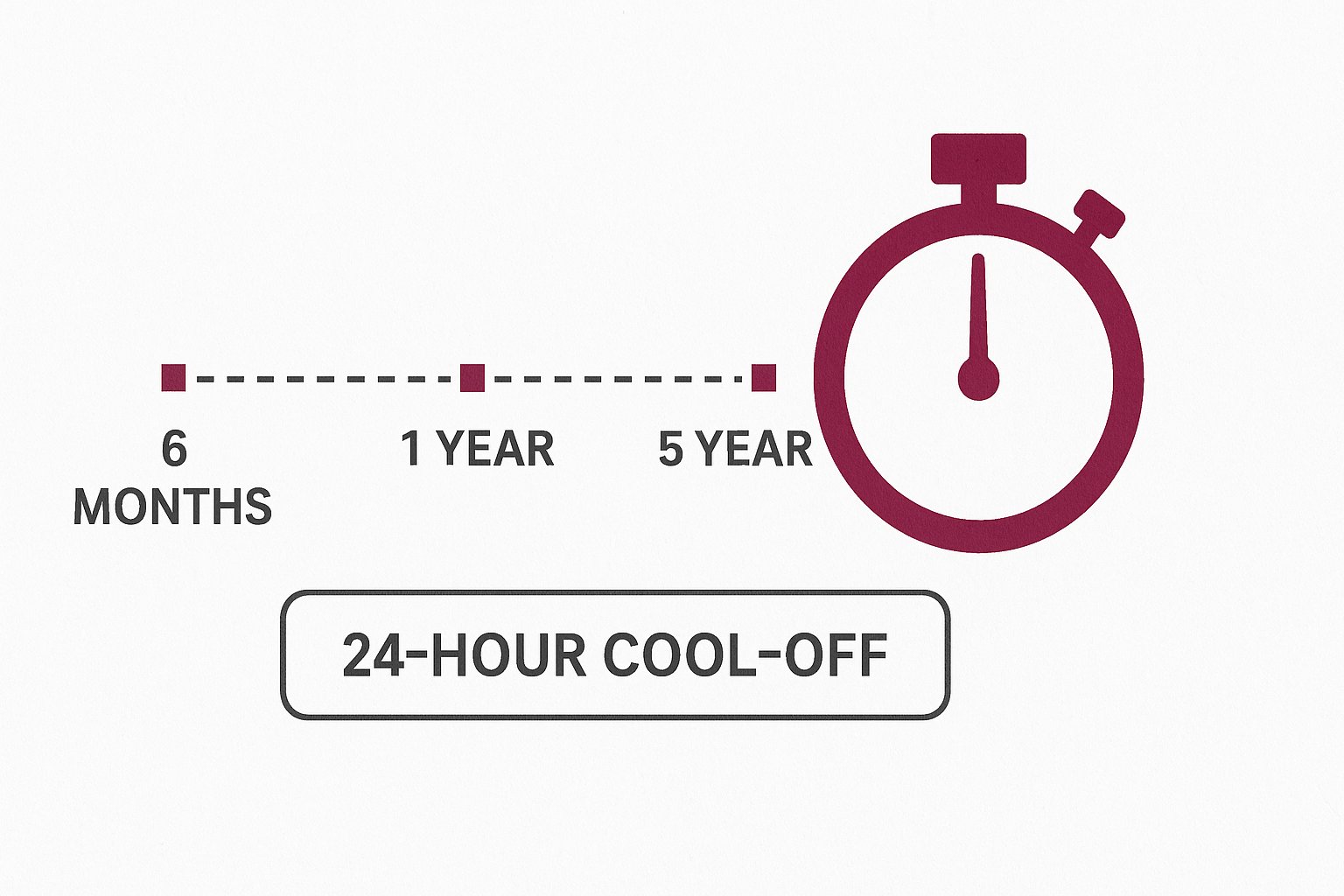
The scheme offers three minimum periods, six months, one year and five years, and the length is chosen by the person registering. Once a period is active it cannot be shortened, which is the point rather than a bug; a commitment device that can be dissolved on the day of a craving spike is no commitment device at all. From a household economics angle the three options are three different bets on how long the reflective self needs the impulsive self out of the licensed market. A six-month period reads as a first line, useful for a person who wants a firm boundary through a tight quarter, a house move, a change of job, or a season in which the household budget cannot absorb variance. A one-year period reads as a full cycle, long enough that a new pattern of weekend behaviour can bed in and long enough for the shape of the annual budget to be redrawn without a gambling line in it. A five-year period reads as a settled decision, the reflective self telling the impulsive self that the whole question is closed for the foreseeable future.
Choosing the length is not a small choice, and the behavioural literature is clear that people tend to underestimate how strong their future selves will be. Present-bias, the tendency to weight the near future more heavily than the further future, cuts the other way here: a person choosing a length whilst calm may pick shorter than the person choosing a length whilst craving would want them to. Because the scheme cannot be shortened once active, the safer error is to choose the longer option and let the auto-expiry deal with any change of heart. That is not advice to over-commit; it is a recognition that under-committing is the more common miscalibration in this domain, and that the household budget over a five-year horizon is generally better served by the longer period than by the shorter.
A closer look
The three-length menu maps quite neatly onto three household planning horizons that a personal finance adviser would recognise. Six months is the horizon over which a household usually rebuilds an emergency fund after a shock, one year is the horizon over which a household completes a full budgeting cycle including annual bills and tax, and five years is the horizon over which a household typically re-plans for a mortgage renewal, a school move, or a career change. Aligning the self-exclusion period with one of those planning horizons is not incidental. It gives the person on the scheme a natural check-in date at which the household budget will already be under review, so that a decision about whether to renew, extend or reconsider is embedded in a wider conversation rather than made in isolation.
03How the block reaches every UKGC-licensed site
The block covers the whole regulated remote market at once, not one operator at a time, and that whole-market reach is the feature that gives the scheme its behavioural weight. A single-site self-exclusion, of the kind operators have offered under their own licences for years, leaves an obvious substitution route open; a person blocked at one licensee can open an account at another before the craving has faded. GamStop closes that substitution route across the licensed set in one action. The database sits with the scheme, and every UKGC remote licensee holds the query pipeline against it, so a person cannot simply try a different brand from the same holding group and get through. From a consumer economics angle the substitution question is central. Where substitutes are easy, a boundary against one product tends not to reduce total spend; where substitutes are eliminated, a boundary is much more likely to hold.
The scheme's reach ends at the UK licensed perimeter, and that boundary is worth stating clearly. Offshore operators, sites that do not hold a UK Gambling Commission remote licence and market to UK residents without one, are outside the block because they are outside the licence that requires it. That is not a bug in GamStop, it is the definition of the scheme; the block covers the market that the regulator supervises. A household that reads GamStop as a whole-internet block will be surprised by the offshore market's existence, whereas a household that reads it as a whole-UK-licensed-market block will not. The distinction matters because the appropriate response to the offshore market is a separate household conversation about consumer protection, payment friction and support services, rather than a complaint that the scheme is failing to do a job it does not claim to do.
04What happens when your period ends
At the expiry date the scheme does not automatically restore access. The person on the scheme has to actively contact GamStop, request that their account be re-enabled, and then wait through a twenty-four hour cool-off before the licensed market opens up again. Nothing lifts the block quietly in the background. That design is the reflective self's insurance policy against the version of itself that would rather drift back in without a conversation, and it is written to make sure the reversal is a conscious act. Households often assume the expiry works the other way around, that the block simply ends at midnight on the last day of the period. It does not. The default at expiry is a continued block, and continued protection, until the person on the scheme takes a specific step to change that default.
What the household actually experiences at expiry, then, is a decision point. The person on the scheme knows the date is approaching, has usually thought about it for weeks in advance, and has to make a choice that is not a small one. A household that has used the period to rebuild its budget will often find at that decision point that the reasons for setting the block in the first place have not gone away. Rent has not become cheaper, wages have not become larger, and the near-miss animations on a slot game have not become less well tuned to the human reward system in the intervening months. The decision to reactivate access, if it is taken, should be taken with those unchanged facts in view rather than under the pull of a returning craving.
Key points
- The minimum period cannot be shortened once active, and that is a feature rather than a friction
- The 24 hour cool-off after expiry is a hot-cold empathy gap safeguard, not a bureaucratic delay
- The 7 year auto-extension turns household inaction into continued protection by default
The twenty-four hour cool-off explained
The twenty-four hour cool-off is the smallest number in the scheme, and behaviourally it is the most important one to understand. Craving research consistently shows that the sharpest peak of an urge lasts under an hour and that most of the impulse-driven spending in an addictive pattern happens inside that peak. Twenty-four hours is designed to sit safely past the peak, so that the person requesting reactivation is a different, calmer decision-maker than the one who felt the urge. Behavioural economists describe this as a hot-cold empathy gap safeguard. A person in a cold, reflective state cannot fully imagine what it will feel like to be in a hot, craving state, and vice versa; the pause makes the person who bears the consequences the one who signs off on the decision.
The pause is also long enough for a household conversation to happen. Twenty-four hours covers a night's sleep, a working day, a school run and an evening meal, all of which are contexts in which the topic can be raised without the noise of a live operator's website in the background. The pause is short enough that it does not feel like a punishment, and long enough that it changes the state of the person deciding. Both properties are needed. A pause of five minutes would be too short to move the person out of the craving state; a pause of a week would feel like an extension of the scheme rather than a decision moment. Twenty-four hours sits in the narrow band where the pause is behaviourally meaningful without being felt as an additional imposition.
A closer look
In household terms the cool-off is also an information-gathering window. It is enough time for the person to look at their bank statement for the previous month, to re-read a household budget they may not have opened in a while, and to speak to a helpline adviser or a family member if they choose. In practical terms, most households in which a self-exclusion has been active for months are also households in which some form of budgetary re-planning has been going on, and the cool-off is the moment that plan gets its final test. If the reasons for setting the block are still valid at the twenty-four hour mark, the reflective self usually walks away from the reversal; if they are not, the reversal proceeds in a much more informed way than an instant reactivation would allow.
06The seven-year auto-extension nobody warns you about
If the person on the scheme takes no action at the expiry of their period, the block continues for a further seven years. That auto-extension is not always the first fact a UK household reads about GamStop, and it is not marketed loudly on the operator side of the licensed market, but it is one of the most consumer-protective defaults in UK financial regulation. Defaults are sticky in the strongest sense; behavioural economics has shown across pension enrolment, organ donation and utility switching that a well-chosen default outperforms even a well-designed opt-in. GamStop's default at expiry is continued protection, and that puts inaction on the safer side of the household budget rather than the riskier one.
The auto-extension also handles a very specific behavioural risk, which is that expiry dates often coincide with periods of household disruption. A person who set a six-month block during a difficult quarter may find that the expiry date arrives whilst a house move, a bereavement, a change of employment or a new child has pushed the calendar into the background. If the default at expiry were reactivation, that person would be quietly returned to the licensed market at exactly the moment their reflective capacity was most stretched. The seven-year extension inverts that risk. The household member who did not have time to think about the block did not have to; the block has stayed on and the household budget has stayed protected.
GamStop and the wider harm-reduction picture
GamStop is one tool in a wider harm-reduction picture, and reading it in isolation tends to underweight the other pieces. UK Gambling Commission licence conditions require operators to run affordability checks, apply stake caps on online slots between two and fifteen pounds under the 2023 White Paper reforms, and fund the Statutory Levy that has been in force since 6 April 2025. Banks offer voluntary gambling blocks on cards. NHS gambling clinics offer structured treatment. The National Gambling Helpline is available around the clock. Each of those tools is doing a slightly different job. GamStop handles the substitution route across the licensed market; the bank block handles the payment rail; the helpline handles the person; the clinic handles the underlying behaviour. In household terms, they are complementary rather than alternative.
The household budget picture is different once several of these tools are in use together. A person on a GamStop period who has also switched on the voluntary gambling block at their bank has closed two substitution routes rather than one, and a household in which the person is also engaged with a helpline or a clinic is one in which the underlying pattern is being addressed, not only the transactions. Layering the tools is not a sign of a lack of trust in any one of them; it is a recognition that behavioural change is easier when the environment supports it, and that the person carrying the pattern is more likely to hold the boundary if the boundary is held on several sides at once.
08Common misreadings of the scheme
Several misreadings of GamStop turn up regularly in the household conversations we hear about. The first is the reading that the scheme is a whole-internet block; it is not, it is a whole-UK-licensed-market block, and the offshore market sits outside that perimeter. The second is the reading that the scheme can be shortened for a good reason; it cannot, and that immovability is what makes it a commitment device rather than a preference. The third is the reading that a paid third-party service can remove a person from the scheme early; no such service exists that can actually do the job, because the database sits on the operator side and no external service has authority over it. The fourth is the reading that the cool-off is a delay; it is a decision window, and it does its work by shifting the person deciding from a hot state to a cold one.
The fifth misreading, and the one that a behavioural economist watches for most carefully, is that the scheme has failed because a person on it has still gambled somewhere. Failure and success are the wrong words for a harm-reduction tool of this kind. The scheme is doing its job whenever a person who would otherwise have deposited at a licensed operator did not deposit, and the fact that the same person may have deposited elsewhere is a separate question with a separate answer. Reading the scheme as an all-or-nothing device sets it up to look like a failure whenever a person has any lapse; reading it as a substitution-reducing device gives a much more accurate picture of what it is doing and where it is helping. Households discussing the scheme together are usually helped by that reframing, because it takes the language of blame off the table and puts the language of design in its place, and it lets the household ask the right question of the scheme, which is not whether it prevents every lapse, but whether it reduces the total volume of licensed-market spending in the pattern being addressed. On the evidence the scheme publishes and on the behavioural literature that framed its design, the answer to that narrower question is that it does, which is what a commitment device is meant to do.
Read next
- The legal position for UK players outside GamStop
- The risks, explained without the marketing
- Payments and checks, banks, cards, crypto, KYC
- Coming off GamStop, the official route
- Getting support, helplines, clinics, family, money
Sources and verification
Verified against public UK sources including gamstop.co.uk for the scheme mechanics, minimum periods, the 24 hour cool-off and the 7 year auto-extension described on this page. Last checked 5 August 2026.
Frequently asked questions
Why is the minimum GamStop period the length it is, in behavioural terms
The shortest period a UK adult can register for is six months, and behavioural research on impulse control is the reason it is not shorter. Craving cycles for a compulsive activity typically fade over weeks rather than days, and a period that ends before the reflective self is back in charge would defeat the purpose of the commitment device. Setting the minimum at six months means the reflective self has time to rebuild its budgeting habits, its household conversations and its coping strategies, so that when the expiry date arrives the person is in a very different state from the one that signed up.
Does the 24 hour cool-off after expiry save real money in a household
Behaviourally, yes, because a large proportion of relapse spending happens inside the first hour of a craving spike. Twenty-four hours is long enough for that spike to fade, for a partner or family member to be looped into the decision, and for the household budget to be looked at with a calmer eye. The pound value saved is not knowable in advance because it depends on how much a person would otherwise have deposited, but the design of the pause maps directly onto the hot-cold empathy gap that behavioural literature has documented in impulsive purchases well beyond gambling.
Can a third party remove me from GamStop before the period is up
No. The technical block sits on the operator side of the connection, held by every UK Gambling Commission licensed site, and no external company can remove a person from the underlying database on their behalf. Any service claiming otherwise is selling a product it cannot deliver. From a household budget perspective the honest advice is to treat any fee paid to such a service as a straight loss, note the pattern for future reference, and let the period run to its scheduled expiry.
How does the seven year auto-extension protect a household budget
The auto-extension turns inaction into protection. If the person on the scheme takes no step at expiry, the exclusion continues for a further seven years, which means that a household distracted by the ordinary business of life is not quietly pushed back into the licensed market by default. Behavioural economics has shown consistently that defaults are sticky, and this default is set on the side of the protective outcome. In household budgeting terms, that saves the reflective self from having to actively defend the boundary every year.
What is the honest description of an offshore site that welcomes GamStop registered users
An operator that markets to GamStop registered UK residents is by definition outside the UK Gambling Commission licensed market, because participation in GamStop is a condition of that licence. Nothing in that arrangement is illegal for the UK adult, but the household should be clear that the site is not covered by GamStop, has no UK complaints route and no fund segregation obligation, and does not share information with the scheme. That is the honest description; anything more flattering is marketing rather than fact.
Talk to someone today
The National Gambling Helpline is free, confidential and open 24 hours a day, seven days a week.